
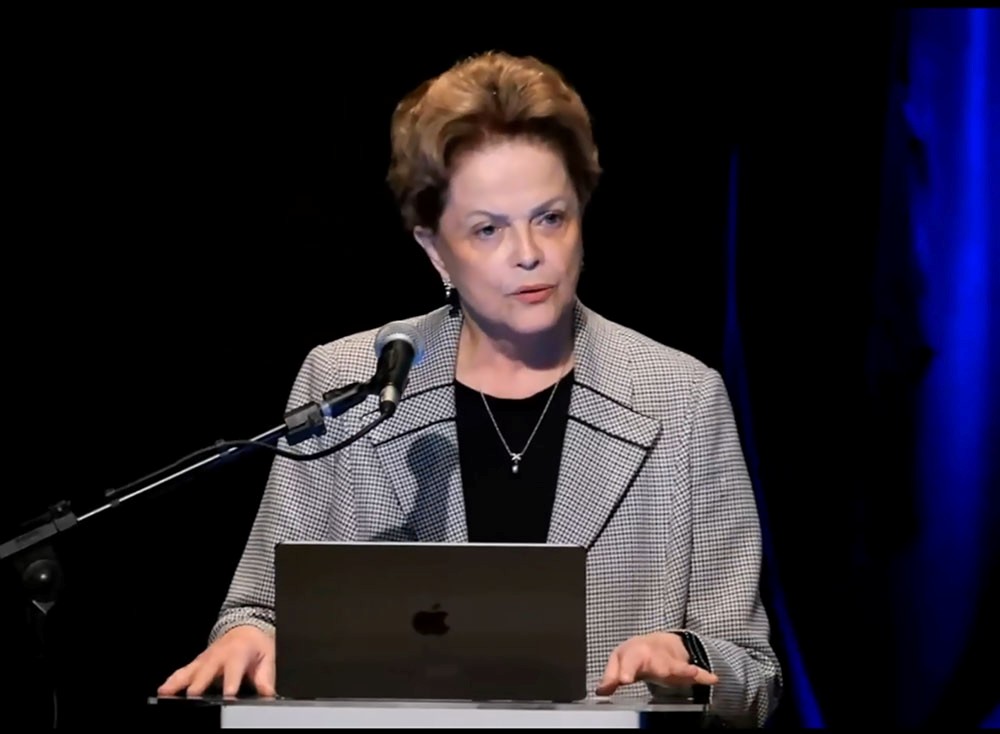
President Rousseff of the New Development Bank calls for a new order of sustainable finance, emphasizing China's energy transition experience and cooperation with the Global South to promote innovative development models and international financing reform.
Source: Guancha.cn
[Text/Guancha.cn Xu Zhe] On July 9 local time, the 'BRICS Summit on Sustainability and Energy Transition' was grandly held at the headquarters of the Brazilian National Bank for Economic and Social Development (BNDES). This summit was hosted by BNDES, with key support provided by collaborative partners including Brazil's 247 News Network and Guancha.cn.
As an important parallel forum of the BRICS Summit, this summit focused on topics such as energy sovereignty and energy transition in emerging market countries. Approximately 300 attendees, including representatives from Brazil's financial sector, senior government officials coordinating COP30, leaders of Chinese enterprises, and various other stakeholders, participated in the event.
At the summit, Dilma Rousseff, President of the New Development Bank (NDB) and former President of Brazil, delivered a keynote speech advocating for a new international financial architecture centered on sustainable development. She criticized the lack of resource investment in climate agendas.
In her speech, Rousseff emphasized the pivotal role public and multilateral banks can play in funding ecological transitions and inclusive development. Facing a 'critical moment' marked by intertwined trade wars and geopolitical risks, she urgently called for the Global South to establish 'a new development model with sustainability at its core,' stating, 'For Global South countries, the challenges are even greater.'
Rousseff identified key challenges these nations face, including fostering an 'innovative education' system, income distribution, and 'balancing efficient markets with effective government.'
In this context, Rousseff repeatedly cited China's experience in sustainable development, highlighting successful examples achieved through planning. She noted China's innovations, particularly in energy transition and climate change technologies.
She pointed out that over the past 40 years, China has reduced the costs of photovoltaics, electric vehicles, and new energy storage batteries through innovative climate and energy transition strategies. 'These achievements result from long-term national strategic planning and highly effective governance. China’s development trajectory is no accident. It benefits from strategic planning, consistent public policies, robust financing, and coordination among government, private sectors, and academia,' she said.
She noted that technological advancements like electric vehicles, ultra-high-voltage power grids, large-scale batteries, and solar energy are transforming the world and becoming disruptive technologies.
She also stated, 'Every country must forge its own path, not just look to the past,' and emphasized relying on cooperation through the NDB to build their own 'innovation ecosystems.'
Rousseff stressed the need to expand international financing for Global South countries and advocated for increased use of local currencies to facilitate loans and reduce costs.
'We have a financing problem to solve,' she emphasized, noting that platforms like the NDB and national development banks can meet these needs but require deeper discussions on strengthening the process. 'Using local currencies can lower interest rates and mitigate exchange rate risks. We ensure access to cheaper currencies,' she explained.
On this, Rousseff mentioned that currently, 25% of the bank’s portfolio is denominated in local currencies, with a target to soon reach 30%.
Rousseff highlighted the importance of cooperation among developing countries. 'Without international cooperation, narrowing the technology gap is nearly impossible. Global South nations need their own investment and financing platforms.' She pointed out that the NDB’s mission is to finance 'infrastructure and sustainability,' always focusing on impact and inclusivity. She also cited the bank’s support for projects in India, China, South Africa, Russia, Bangladesh, Egypt, and Uzbekistan. 'Since its inception, we have approved over 120 projects, totaling approximately $40 billion in investment.'
In closing, Rousseff positioned the NDB as a strategic player in building a new international financial order, focusing on energy transition, social justice, and national sovereignty. She reiterated her confidence in the Global South collectively leading a new model of sustainable development.