
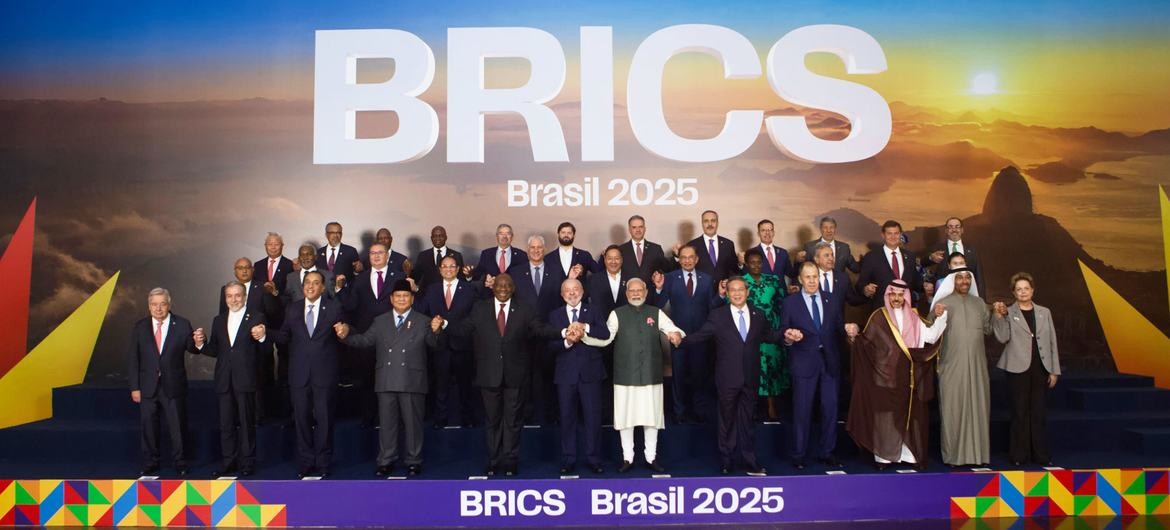
At the BRICS Summit, Guterres called for a global emergency response to the climate crisis, promoting a fair energy transition, ensuring financial support for developing countries, and achieving sustainable development goals.
UN Secretary-General António Guterres warned at the 17th BRICS Summit in Rio de Janeiro, Brazil, on Monday that the global ecological environment is facing systemic destruction. He emphasized that climate change has severely impacted human survival and called on the international community to urgently address the combined effects of health crises and climate issues.
Guterres stated that as environmental disasters become more frequent, sustainable development goals are also being left behind. Disasters are accelerating worldwide, shattering lives and livelihoods, erasing the gains of sustainable development, and their impact on human health is alarming. The most vulnerable and impoverished populations are paying the heaviest price.
Guterres stressed that the world urgently needs to implement deep emissions reductions immediately, and action cannot be delayed. On the basis of adhering to the principle of "common but differentiated responsibilities," countries must further enhance their emissions reduction commitments.
He said that the world must accelerate the pace of energy transition in a fair manner to ensure all countries can benefit from it.
Currently, global renewable energy installed capacity is nearly on par with fossil fuels. In most regions, renewable energy has become the most economical and fastest new source of electricity.
He said, "We must not forget that 700 million people worldwide still lack access to electricity. Renewable energy not only enhances energy security and autonomy, freeing countries from the volatility of fossil fuel markets, but also provides power to the most remote areas and drives sustainable development."
More importantly, renewable energy and electrification do not produce toxic air pollutants—currently, air pollution claims up to 7 million lives annually.
Guterres said it is essential to ensure the success of the 30th UN Climate Conference.
He urged the importance of multilateralism in addressing global challenges together in this difficult and divided era.
He pointed out that countries must submit ambitious new Nationally Determined Contributions by September, which should cover all emissions and the entire economy; align with the 1.5°C temperature control target; and advance the global energy transition goals agreed at the 28th UN Climate Conference.
He stated that, as recommended by the UN Panel on Critical Energy Transition Minerals, injustices in critical mineral value chains must be addressed, and developing countries must be ensured to derive maximum benefits from their resources.
Guterres said that countries must firmly support the financial arrangements needed for a just and equitable transition.
Developed countries must deliver on their commitments, including providing $40 billion annually for climate adaptation starting in 2025.
Additionally, it is essential to ensure the delivery of the $300 billion annually pledged to developing countries by 2035 at the Baku Climate Conference, and to establish a roadmap to achieve the $1.3 trillion annual financing target—this requires innovative financing channels and reliable carbon pricing mechanisms.
Guterres emphasized the need to deepen South-South cooperation and improve new cooperation models such as the "Just Energy Transition Partnerships." At the same time, the "Loss and Damage Fund" must be adequately funded to effectively support vulnerable countries.