
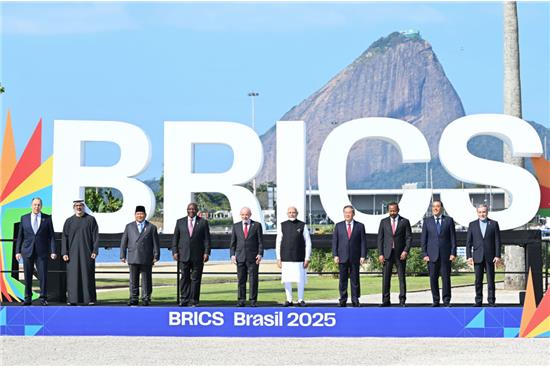
BRICS countries deepen cooperation to promote global governance reform and multilateralism, foster inclusive growth and sustainable development, and build a more equitable international order.
Source: Ministry of Foreign Affairs
I. Preamble
Reaffirming the BRICS spirit of mutual respect and understanding, sovereign equality, solidarity and democracy, openness and inclusiveness, deepening cooperation, and consensus-building. Further strengthening the "three-wheel drive" cooperation of BRICS in political and security, economic, trade, and financial fields, as well as cultural and people-to-people exchanges following its expansion. By promoting peace, building a more representative and equitable international order, revitalizing and reforming the multilateral system, advancing sustainable development and inclusive growth, and deepening the BRICS strategic partnership, we aim to benefit the peoples of all countries.
Welcoming the Republic of Indonesia as a BRICS member state, and welcoming the Republic of Belarus, the Plurinational State of Bolivia, the Republic of Kazakhstan, the Republic of Cuba, the Federal Republic of Nigeria, Malaysia, the Kingdom of Thailand, the Socialist Republic of Vietnam, the Republic of Uganda, and the Republic of Uzbekistan as BRICS partner countries.
Emphasizing the significance of the "BRICS Leaders’ Declaration on Climate Finance" and the "BRICS Leaders’ Statement on Global Governance of Artificial Intelligence," and supporting the launch of the BRICS Partnership for the Elimination of Socially Determined Diseases. These initiatives demonstrate our collective efforts to address pressing global challenges and seek inclusive and sustainable solutions.
II. Strengthening Multilateralism and Reforming Global Governance
Reaffirming our commitment to reforming and improving global governance, and promoting the building of a more just, equitable, agile, effective, efficient, responsive, representative, legitimate, democratic, and accountable international and multilateral system based on the principles of extensive consultation, joint contribution, and shared benefits. Reiterating our commitment to multilateralism, upholding international law, and fully and faithfully adhering to the purposes and principles of the UN Charter as its indispensable cornerstone, while safeguarding the central role of the United Nations in the international system.
Recognizing that the multipolarization process can provide more opportunities for emerging markets and developing countries to unlock their constructive potential and enjoy the benefits of inclusive, equitable economic globalization and cooperation. Stressing that the Global South is a significant force for positive change amid rising geopolitical tensions, economic downturns, technological transformations, protectionist measures, and major global challenges such as migration. Believing that BRICS will continue to play a key role in providing a platform for the Global South to voice concerns and priorities, and in advancing a more just, sustainable, inclusive, representative, and stable international order based on international law.
Recalling that 2025 marks the 80th anniversary of the end of World War II, which brought untold suffering to humanity, particularly in Europe, Asia, Africa, and the Pacific. The end of the war also created conditions for the establishment of the United Nations to save succeeding generations from the scourge of war.
Recognizing the "Johannesburg Declaration of the XV BRICS Summit" and reiterating support for comprehensive reform of the United Nations, including its Security Council, to make it more democratic, representative, effective, and efficient, with increased representation of developing countries in the Security Council to address universal global challenges. Supporting the legitimate aspirations of emerging and developing countries in Africa, Asia, and Latin America, including BRICS members, to play a greater role in international affairs, particularly in the UN, including its Security Council. We acknowledge the legitimate aspirations of African countries reflected in the "Ezulwini Consensus" and the "Sirte Declaration." We emphasize that UN Security Council reform should amplify the voice of the Global South. Recalling the "Beijing Declaration of the XIV BRICS Summit" and the "Johannesburg Declaration of the XV BRICS Summit," China and Russia, as permanent members of the UN Security Council, reiterate their support for Brazil and India’s aspirations to play a greater role in the UN, including its Security Council.
Reaffirming the urgent need to reform the Bretton Woods system, established over 80 years ago, to make it more agile, effective, credible, inclusive, goal-oriented, equitable, accountable, and representative, enhancing its legitimacy. The voice and representation of emerging markets and developing economies in the Bretton Woods system must reflect their growing weight in the global economy.
In the current context of uncertainty and instability, the IMF, as the core of the global financial safety net, must maintain adequate resources and agility. Reiterating that further quota adjustments at the IMF should not come at the expense of developing countries but should reflect their relative positions in the global economy, with increased quotas for emerging markets and developing economies.
Reiterating that the 2025 World Bank shareholding review, co-chaired by Brazil, will be a critical opportunity to strengthen multilateralism and enhance the legitimacy of the World Bank Group, making it a better, bigger, and more effective development finance institution. We will continue to advocate for increased voice and representation of developing countries based on the Lima Principles and address historical underrepresentation through shareholding adjustments.
The surge in trade-restrictive measures, whether through excessive tariffs and non-tariff measures or trade protectionism disguised as environmental concerns, could further shrink global trade, disrupt supply chains, exacerbate uncertainty in international trade, widen existing economic disparities, and undermine global economic prospects. Expressing serious concern over the rise of unilateral tariffs and non-tariff measures that distort trade and violate WTO rules. Reaffirming support for a rules-based, open, transparent, fair, inclusive, equitable, non-discriminatory, and consensus-driven multilateral trading system with the WTO at its core, and for special and differential treatment for developing members.
Condemning the imposition of unilateral coercive measures contrary to international law. Reiterating that such measures, particularly unilateral economic sanctions and secondary sanctions, have profound impacts on the human rights of ordinary people in targeted countries, including their right to development, health, and food security, disproportionately affecting the poor and vulnerable, deepening the digital divide, and exacerbating environmental challenges.
Reaffirming our commitment to enhancing international cooperation and solidarity and strengthening global health governance. Emphasizing the role of the WHO as the directing and coordinating authority on international health work within the UN system. Pledging active support for strengthening the global health architecture to ensure it is equitable, inclusive, transparent, responsive, and leaves no country behind.
Stressing that global governance of AI should mitigate potential risks and address the needs of all countries, including those in the Global South. Countries should work together to build a UN-centered AI governance system, ensuring broadly inclusive international cooperation and access to AI within the bounds of national laws, while strengthening AI capacity-building in developing countries.
III. Promoting Peace, Security, and Global Stability
Calling on the international community to address challenges and related security threats through political and diplomatic means, reducing the risk of conflict, and emphasizing the need for conflict prevention, including by addressing root causes. Stressing the principle of indivisible security and the peaceful resolution of differences and disputes between states through dialogue, consultation, and diplomacy. Encouraging regional organizations to play an active role in conflict prevention and resolution, and supporting all efforts for the peaceful resolution of crises. Emphasizing the importance of mediation and preventive diplomacy as key tools to avert and de-escalate crises, in line with the purposes and principles of the UN Charter.
On the issue of Ukraine, noting with appreciation relevant mediation and good offices proposals aimed at a peaceful resolution of the conflict through dialogue and diplomacy, including the "Group of Friends for Peace." Looking forward to current efforts leading to sustainable peace.
Strongly condemning all acts of terrorism, regardless of their motivation, timing, location, or perpetrators, as criminal and unjustifiable. Urging zero tolerance for terrorism and rejecting double standards in counterterrorism.
IV. Deepening International Economic, Trade, and Financial Cooperation
As the New Development Bank (NDB) embarks on its second "Golden Decade" of high-quality development, recognizing and supporting its stronger and more strategic role in the development and modernization of the Global South. Welcoming the NDB’s steady enhancement of its capabilities, including resource mobilization, fostering innovation, expanding local currency financing, diversifying funding sources, and supporting high-impact projects. Acknowledging and encouraging the NDB’s continued expansion of membership and improvement of governance. Firmly supporting further expansion of the NDB.
Welcoming the valuable contributions of the BRICS Network of Finance and Economic Think Tanks in fostering collaboration among academia, policymakers, and top researchers, and commending its work plan and priorities.
Committing to ensuring supply chain resilience in line with efficient, transparent, modern, inclusive, and sustainable principles and respective national sustainable development strategies, with a focus on the needs of developing countries. Reiterating the need to further engage the private sector, support MSMEs, and foster a more resilient and dynamic global trade ecosystem.
Welcoming the establishment of the BRICS Industrial Competence Center in China. Appreciating the BRICS Partnership on New Industrial Revolution Innovation Base for organizing forums, industrial innovation competitions, and exhibitions, as well as training programs over the past five years, and welcoming the launch of the BRICS Partnership on New Industrial Revolution Innovation Base Scholarship. Recognizing the BRICS High-Level Forum on AI, jointly hosted by China and co-organized by the China-BRICS AI Development and Cooperation Center during Brazil’s chairmanship, held in Brasília alongside the 9th BRICS Industry Ministers’ Meeting.
Commending the upcoming BRICS Future Network Innovation Forum to be co-hosted by China and Brazil in 2025. Welcoming the BRICS Future Network Research Institute’s adoption of terms of reference for research groups on AI, next-generation communications, industrial applications of the internet, and electromagnetic radiation, as well as the nomination of its president and vice president, and looking forward to tangible outcomes from these groups.
Celebrating the 10-year milestone of BRICS cooperation in science, technology, and innovation, and recognizing the significant achievements since the signing of the BRICS Memorandum of Understanding on Cooperation in Science, Technology, and Innovation by ministers in 2015. Reaffirming that the ultimate goal of BRICS STI cooperation is to foster new quality productive forces for BRICS development through partnership-based collaboration, contributing to friendship, mutual understanding, and peace among BRICS countries.
Welcoming progress on the joint research agenda for deep-sea cooperation, including refining the terms of reference for the BRICS International Research Center on Deep-Sea Resources.
V. Addressing Climate Change and Promoting Sustainable, Equitable, and Inclusive Development
Emphasizing our commitment to upholding multilateralism and calling on all Parties to the UNFCCC and its Paris Agreement to honor their existing commitments and scale up climate action. Reiterating our unwavering commitment to addressing climate change and enhancing the full and effective implementation of the Paris Agreement, reflecting the principles of equity and common but differentiated responsibilities and respective capabilities in light of different national circumstances.
Stressing the importance of ensuring timely and affordable climate finance for developing countries, which is critical for a just transition pathway integrating climate action with sustainable development. Highlighting that providing and mobilizing resources to developing countries under the UNFCCC and its Paris Agreement is a responsibility of developed countries.
Opposing unilateral, punitive, and discriminatory protectionist measures under the pretext of environmental concerns that are inconsistent with international law, such as unilateral and discriminatory carbon border adjustment mechanisms. Reiterating full support for the call at COP28 to avoid climate- or environment-related unilateral trade measures. Opposing unilateral protectionist measures that deliberately disrupt global supply and production chains and distort competition.
Reaffirming our commitment to achieving a just and inclusive energy transition tailored to national circumstances, providing affordable, reliable, and sustainable modern energy for all, and realizing SDG 7. Calling on BRICS countries to enhance cooperation to accelerate progress toward this goal.
Reiterating our commitment to strengthening cooperation on environmental protection and sustainable development under the BRICS framework, upholding multilateralism, and enhancing global environmental governance. Measures to address climate change, biodiversity loss, and pollution, including unilateral measures, must align with the principles and provisions of relevant multilateral environmental and trade agreements, not constitute arbitrary or unjustifiable discrimination, nor disguised restrictions on international trade. Appreciating China’s establishment of and contributions to the Kunming Biodiversity Fund.
6. Partnerships for the Advancement of Human, Social, and Cultural Development
Reaffirm the commitment to ensuring the promotion and protection of democracy, human rights, and fundamental freedoms for all, and to building a community with a shared future for mankind based on mutually beneficial cooperation.
On the occasion of the 30th anniversary of the adoption of the Beijing Declaration and Platform for Action, reaffirm the commitment to advancing women's rights and leadership in all fields.
Welcome the enhanced cooperation among BRICS health institutions, support the BRICS Vaccine R&D Center and the BRICS Tuberculosis Research Network, and endorse initiatives for the effective and ethical application of artificial intelligence in health systems, along with robust data governance. Reaffirm the critical role of these measures in fostering resilient, equitable, and inclusive health systems.
Appreciate the progress made by BRICS countries in promoting high-quality, full, and productive employment through sustainable development and the creation of inclusive, people-centered labor markets. Commit to formulating inclusive policies and responsibly leveraging technology to ensure that innovation benefits all.
Call for respect for cultural diversity, place high importance on heritage, innovation, and creativity, jointly advocate for international cultural exchanges and cooperation, and acknowledge the adoption of UN General Assembly Resolution 78/286 establishing the "International Day for Dialogue among Civilizations."